CMU and Feng Chia University Co-Teach Climate Resilience Course; Former Minister簡又新 Calls for Building a Resilient Community in Central Taiwan
From healthcare services amid extreme climate events to urban disaster preparedness and interdisciplinary talent development, the lecture explored how universities can strengthen regional resilience.
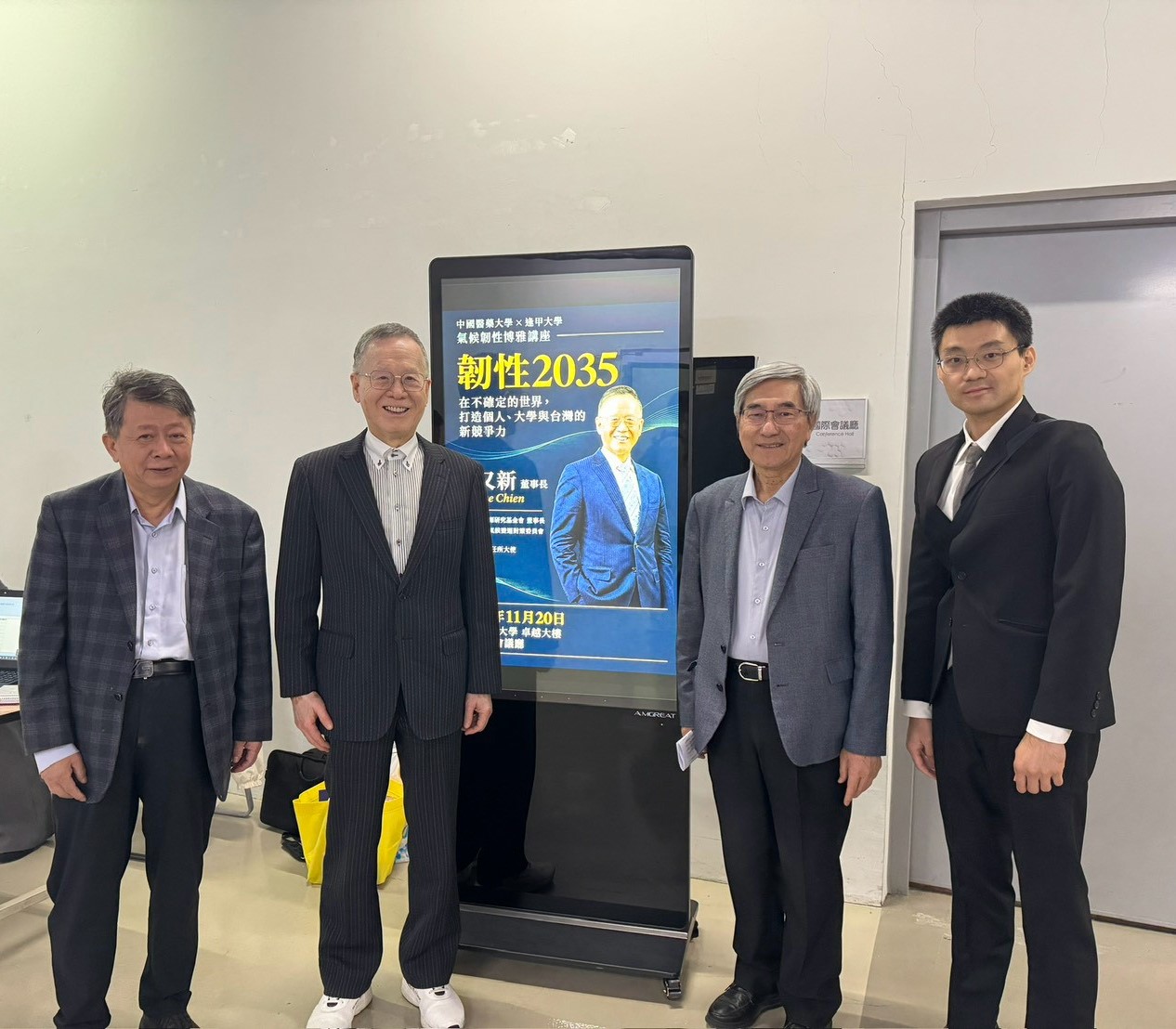
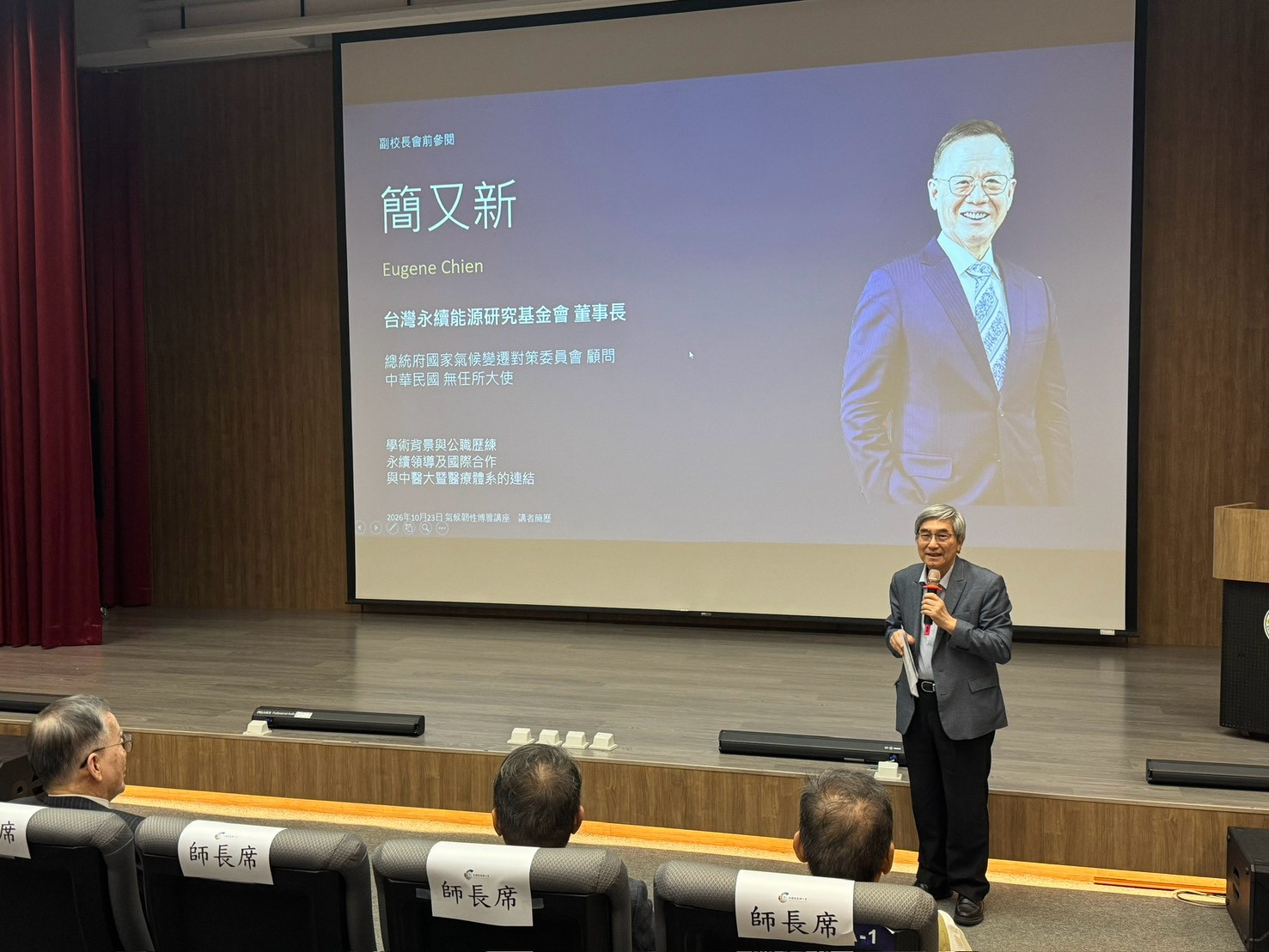
As extreme weather disrupts transportation, power supplies, and healthcare services, how can cities maintain essential operations and ensure that people in need continue to receive medical care? China Medical University (CMU) and Feng Chia University jointly launched a course on “Climate Resilience” in the 2026 academic year. On November 20, the third lecture in the series was held at CMU, featuring Dr. Y.S. Chien, Chairman of the Taiwan Institute for Sustainable Energy and Advisor to the Presidential Office's National Climate Change Committee. He delivered a keynote speech entitled “Resilience 2035: Building New Competitiveness for Individuals, Universities, and Taiwan in an Uncertain World.” Dr. Chien proposed the concept of a “Resilient Community in Central Taiwan,” encouraging the two universities to combine their expertise in healthcare, engineering and technology, and urban disaster preparedness to jointly explore regional risk early-warning systems, emergency response collaboration, and talent development.
Integrating Healthcare and Urban Disaster Preparedness: Dr. Chien Proposes a Framework for Regional Collaboration
Dr. Chien noted that CMU has strong expertise in smart healthcare, public health, and healthy aging, while Feng Chia University has accumulated considerable strengths in engineering, artificial intelligence, smart cities, and disaster prevention technologies. Building on these complementary strengths, the two universities could work toward two key objectives: ensuring the continuity of healthcare services and maintaining uninterrupted urban operations. This would involve exploring how urban emergency response systems and medical resource allocation can support one another during disasters.
He further recommended integrating urban disaster preparedness data with healthcare capacity information to develop a regional risk map covering compound disasters and health risks in Central Taiwan. By connecting universities, hospitals, businesses, and local governments, the two institutions could assess the feasibility of establishing a joint emergency response platform and explore applications of AI-powered early-warning systems and digital twins for critical infrastructure. Regarding talent development and knowledge exchange, he proposed exploring the establishment of an inter-university “Resilience Leadership Academy,” developing a Regional Resilience Index and action reports, and sharing Central Taiwan's practical experiences through international forums.
From Net Zero to Climate Adaptation: Safeguarding Healthcare Services Amid Crises
In his welcoming remarks, CMU Vice President Lin Cheng-Chieh emphasized the close relationship between climate change and human health. During extreme weather events, the continuity of healthcare services and the timely provision of care for older adults and vulnerable populations are critical issues that medical education and public health must address. He encouraged students to extend their professional knowledge and skills into communities and environmental initiatives, while reflecting on their responsibilities toward public health.
Dr. Chien explained that resilience encompasses the abilities to anticipate, withstand, recover, adapt, and transform. In response to extreme heat, emerging infectious diseases, population aging, and healthcare supply chain risks, healthcare systems should incorporate climate adaptation, public health, medical backup arrangements, and health equity into their governance frameworks while pursuing net-zero goals. He also reminded participants that the adoption of artificial intelligence in smart healthcare must go hand in hand with considerations of power supply stability, data security, and human oversight to ensure the continuity of healthcare services during emergencies.
Co-Teaching Climate Resilience Across Universities: Cultivating the “Six Resilience Competencies” in the AI Era
Drawing on his own career journey from aerospace engineering research to environmental governance, transportation, and diplomatic affairs, Dr. Chien highlighted the importance of continuous learning and interdisciplinary collaboration. He introduced the “Six Resilience Competencies”: learning, adaptability, integration, innovation, collaboration, and a sense of mission. He encouraged students to make effective use of artificial intelligence while continuing to develop their ability to ask meaningful questions, exercise independent judgment, and take responsibility for their decisions. He concluded with an encouraging message to students from both universities: “Competence determines how fast you can go; a sense of mission determines how far you are willing to go.” He urged students to consider how their professional expertise could be applied to address societal needs.
The Climate Resilience course is jointly taught by CMU Distinguished Professor and Chief Sustainability Officer Li Cheng-Chun, Assistant Professor Hsu Chin-Yun, and Feng Chia University Distinguished Professor Wu Chih-Chao. Six experts and scholars have been invited to share their insights on topics including climate adaptation, healthcare, and sustainability governance. Associate Professor Teng Yu-Kuei from CMU's Department of Nursing and other faculty members also attended the lecture. Dr. Chien concluded by emphasizing the complementary roles of the two universities: “Feng Chia University safeguards the safety of our cities, China Medical University safeguards the health of our people, and together, the two universities safeguard the future of Central Taiwan.”